


In the maritime industry, safety is a critical engineering discipline that must never be left to chance. During night navigation, offshore operations, or in challenging weather conditions with reduced visibility, one of the most essential elements ensuring navigation safety is undoubtedly the system of aids to navigation. However, manufacturing high-quality equipment alone is not enough; its ability to deliver the promised performance under the harshest operating conditions must also be verified.
The performance of a marine lantern cannot be evaluated solely by its electronic design, mechanical durability, or advanced LED technology. Verifying that the product fully achieves the optical performance specified during the design stage is one of the most critical steps of a professional quality assurance process.
Light intensity, visibility range, color chromaticity, horizontal and vertical beam distribution, and flash characteristics are the fundamental optical parameters that directly determine the lantern's performance in the field. Even the slightest deviation caused by the manufacturing process can prevent the lantern from being recognized at critical moments at sea. For this reason, at SonarSea, optical testing is not limited to the product development phase; every single marine lantern undergoes comprehensive optical testing individually before shipment.
A Meticulously Executed Optical Testing Process
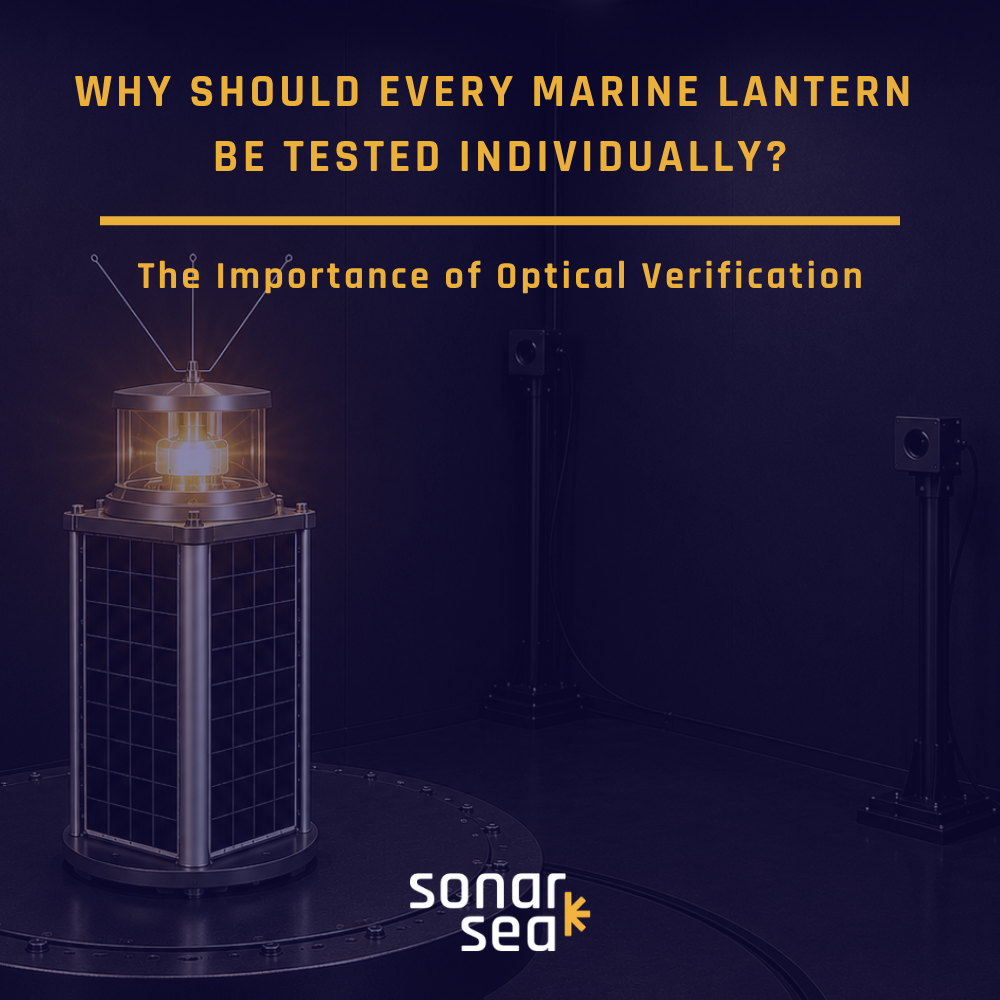
Every marine lantern that completes the production line undergoes rigorous inspection in SonarSea's optical testing laboratory. Rather than relying solely on theoretical standards, each unit is verified against the demanding conditions of real-world maritime operations based on the following key criteria:
- Visibility Range: Using precise lux measurements and engineering candela calculations, the lantern's ability to achieve the specified visibility distance in accordance with international standards is verified.
- Color Chromaticity: Compliance with the specified color standards is carefully measured and confirmed.
- Horizontal and Vertical Light Distribution: The uniformity of the beam angles is analyzed to ensure optimal visibility from every direction.
- Flash Characteristics and Timing Accuracy: The flash frequency and timing are tested to ensure precise and consistent operation.
This multi-layered testing process eliminates even the smallest production variations, ensuring that every marine lantern delivered provides consistent, reliable, and standardized high performance.
Individual Testing Instead of Sample-Based Inspection: A Quality Philosophy That Sets Us Apart
Many manufacturers rely on statistical sampling methods, inspecting only a limited number of products from each production batch to reduce costs or accelerate production. At SonarSea, however, our quality philosophy is based on individual verification rather than statistical sampling.
Even for large-volume orders, no exceptions are made. Every marine lantern leaving the production line is individually tested in our laboratory. This uncompromising approach not only guarantees consistent product performance but also ensures complete traceability throughout the manufacturing process.
Transparent and Reliable Delivery with Individual Test Reports
Every marine lantern that successfully passes all optical testing procedures is packaged together with its own Test Report, documenting the laboratory measurement results specific to that individual unit.
This allows customers to rely not only on catalog specifications or theoretical performance values but also on verified measurement data for the exact product they receive.
At SonarSea, quality control is not simply the final stage of manufacturing—it is our commitment to delivering documented, verified, and dependable performance that customers can trust even in the most demanding marine environments.